Showing posts with label hospice. Show all posts

Sunday, November 16, 2014

Lows and lows

"Nothing is permanent in this wicked world - not even our troubles."
- Charles Chaplin

It was my last Friday on the wards for this go-round, the last day our current two teams would spend together before all the non-interns switched over. And from noon onward, it turned into an emotional roller coaster I struggled to navigate.

Code Blue, ICU. Code Blue, ICU.
My attending and I were on our way down to the ER to see a new admission when a code was called in the ICU. The ICU staff is the rapid response team, so typically the floor doctors don't descend en masse; a few people headed over there while we two continued our trek downstairs.

Our admission was a very elderly lady with late-stage Alzheimer's who had fallen victim to a vicious infection and recently stopped eating. Her family had made her 'comfort measures only,' and she was being admitted for gentle care until hospice services could be put in place for her to receive care at home.

Spindly fingers. Raspy breaths. Vacant eyes.
Her room was crowded with family and her caretakers. Her presentation, from so many angles (minus the infection), bore strong echoes to my grandfather's last days. My attending spoke to the children as I held her hand, thinking back to when I last saw him, similarly cachectic and lost to the world in all ways except for the air his lungs still pulled in, the blood his heart still labored to pump.

After talking to the family and the ER doctor, we made our way back upstairs. Just as I was settling into my seat to work on her admission orders, a second code was called in the ICU for the same patient. They needed more hands on deck for CPR, and several of us rushed over.

1--2--3--4--5--6--7--8--9--10-- x 2 minutes
The patient's room was the one right next to the room where my patient's harrowing code had occurred one month ago, when I was working in the ICU. Half of the staff was the same that had been present that day. When I was struggling in the aftermath of the code last month, one of my medical school mentors told me, "Events like that tend to stay entrenched in your memory for the rest of your life. You'll always remember the details." It's only been a month, too soon to extrapolate to a lifetime, but I had flashbacks that Friday in a way I never had before. But there was no time to indulge (there rarely is); time to be present.

After some time, the family asked us to stop, and the code was called. Those of us who had come to help trudged back to the wards with a heavy heart, back to the grind of work. My resident had finished the admission orders for me, and I began the admission note. Soon after, my pager went off -- please call radiology.

Peritoneal carcinomatosis. Subcapsular splenic lesions. Periaortic lymph nodes.
They had CT scan results back for another one of my patients, a sweet, feisty elderly lady who had come in with intractable vomiting and unintentional weight loss. The results were grim. She had widespread metastases, likely related to a past cancer for which she had undergone treatment years ago.

I called her primary care doctor to give him the update. He came by the wards within the next hour, and we went to deliver the somber news to our patient. She took it in with her usual stoicism, giving little hint as to how she was feeling, and little room for us to explore that with her.

Olé!
What was left of the day went toward tying up loose ends and finishing paperwork. And was then followed by the final jarring event of the day -- a celebratory two-team dinner to feast to our time together, which had been scheduled since several days prior.

I wouldn't say I ran the full spectrum of emotions that day, because mostly I wallowed at one end of it, and had to play-act at the polar opposite end for the final few hours of an otherwise exhaustingly mournful day. There were too many echoes in speedy succession -- of my grandfather, of my ICU code, of my first medicine patient I had as a third-year medical student, who happened to be the first patient I had to break the news about cancer to, and the first patient I had transferred to the ICU, only to see him die a slow, sad death there.

Somehow that Chaplin quote seemed to belong with my memories of this particular Friday. When I was an MS-III with my first patient with newly diagnosed cancer, while simultaneously struggling to process my aunt's sudden and tragic death, my intern at the time would say, "This too shall pass." And more recently, as I struggled through that Friday, and some of the days leading up to it, another mentor/friend told me of her dance party with her adorable son to Taylor Swift's "Shake It Off."

How can we build in time to do that? I hadn't fully internalized what a wild, visceral ride I went on that day until over a week later. It was after I transitioned back to an 8a-5p schedule, had caught up on some sleep, and found myself with a two-day weekend to finally try and decompress.

There has to be a better structure for processing, even within the constraints placed upon us by training. How else will we stem that empathy degradation we keep hearing about?

Things to ponder. In the meantime, if you see me jamming to TSwift, all I will say is, don't knock it 'til you try it. 

Sunday, April 7, 2013

80 on 97 at 86.5


 [Disclaimer: Names and all sorts of details have been changed to maintain confidentiality. As such, any resemblance to real persons, living or dead, is coincidental.]

“Mr. Maddox is an 86-year-old gentleman with end-stage congestive heart failure, but you won’t believe it when you walk into his room. You’ll see what I mean when you meet him, he looks nothing like a congestive heart failure patient, it’s remarkable!”

A doctor spends her career as a voyeur to her patient's life – births, birthdays, graduations, jobs, marriages, divorces. Tragedies. Deaths. Ultimately, even we are powerless in the face of time and fate. When we accept our impotence, we stop being physicians and become Charon, ferryman of the dead. We bulwark our patients and their families as they pick the next turn. And for the token of their trust, we ease their way across Acheron and Styx.

I spent a recent morning playing voyeur, rounding on the team’s ICU patients – four individuals at different distances down the Styx – with the hospice team attending, Dr. Slate. Two of the ICU patients were in no condition to talk; in fact, they had been unconscious for several days at least. In a twist of fate, perhaps, these were the two youngest patients on the list, in their late 40s to early 50s, the parchment of their life stories prematurely shorn.

Rob was 49, a young professional with an even younger family. He had been expected to die overnight after a terminal extubation, but miraculously pulled through the night. Rob had been in a coma for weeks, missing his daughter's birthday, his wife's promotion. After those weeks of silence and agony, his wife came to the heartbreaking decision to let him go. She brought their little girl in one last time to say good night to her daddy. They kept vigil for hours, watching his breathing peter out. As the sun rose, the shifts changed. When we rounded, his brother was in the room with him, watching over his last seconds…minutes…hours, losing the battle to lung cancer.

 Our other young gentleman, Carl, recently married, had also fallen victim to lung cancer. He had complete white-out of the right lung, maybe complicated by pneumonia, it was hard to tell. He was close to failing respiratory therapy when we checked in on him and had not woken up in days. His wife, sister and mother were coming in the afternoon for the first of many family meetings. There would be questions about his diagnosis, his prognosis. His mother would ask if he was in any pain. His sister would ask what their options were. His wife would ask if he was ever going to wake up.

No decisions would be made today.

These first two patients were non-communicative, obtunded, potentially locked in their own bodies. Dr. Slate told Rob’s brother that even though he appeared asleep, the drugs did not put him to sleep. They merely sedated him enough to dull the pain – he could still hear.

I remember when Barimama, my grandmother, lost her memory after a stroke and became bedridden and aphasic. She could only communicate by singing hymns – we were still granted the gift of her voice, but our voices never reached her again. We had a diagnosis, but no prognosis. If she was in pain, she could not tell us. She was awake, but oblivious to the world. We could only stand by as she drifted farther and farther.

We knew everything, and yet, nothing. No decisions were made.

“He has an ejection fraction of less than 10 percent. He also has a history of pulmonary disease, esophageal cancer status-post resection. His wife of 50 years died two years ago.”

Our other two ICU patients were older, lonelier gentleman, with no families to turn to. Keith, a 90+ year-old partially deaf man with recurrent colon cancer, was cantankerous and jonesing to get out of the hospital. “My doctor on TV there, he told me I can go home today!” he kept eagerly repeating to us. “Get these things offa me and let me walk outta here now!” His daughter was his health care proxy, and she had the clarity of knowing his wishes: no life support, only hospice. So sure enough, we got ‘those things’ off of him and shifted him downstairs to the hospice unit.

Next door was a patient who had inexplicably lapsed into a five-day coma, and even more inexplicably spontaneously woke up a day before the team planned to terminally extubate him. Sidney was a long-term alcoholic who had broken off ties with his family years ago. His wife was long-gone, his children long-estranged. Sidney had no advocate to speak for him – he would become a ward of the state. He was still intubated, with an unclear degree of comprehension and inevitable, significant neurological impairment. Of all our patients, his future was perhaps the most uncertain.

The aftermath of this ICU morning would leave a little girl without a father, and a new bride without her husband. Meanwhile, two older gentleman with lives fully lived would linger on in hospice care, with the scythe of death precipitously teetering over them, biding its time. It is tempting, and too easy, to try to weigh one life against another. It is even easier to embrace bitterness and cynicism when you find the way the scales fall to be unsatisfactory, "unfair." The key, perhaps, is to leave any sense of justice checked at the doorstep. The hospital has no room for it, only for empathy and care regardless of circumstance.

“He requested to become DNR/DNI on this admission, and is filling out an advanced directive with his daughter this afternoon.”

Our attending described one of the non-ICU patients as a case of “wrongful life.” Jackie was a 90+ year-old lady found passed out face-down on her kitchen floor, to our surprise from drinking too much. “And you think this upstanding little old lady couldn’t possibly be swizzling alcohol,” Dr. Slate said. Unbeknownst to EMS, she had a DNR/DNI order, and yet she had CPR performed, was revived and brought to the hospital. Hence, “wrongful life.” Now she was debilitated and stuck on life support until and unless her family decided otherwise.

Situations like this are not unfamiliar. National news headlines and cable TV themes thrive on showcasing family drama revolving around terminal care. But it isn't drama. It's love. Basic human nature dictates, it is always harder to actively choose to deprive your family member of care than it is to not provide it in the first place.

Dr. Slate told us it is our job to empower our patients' families. "Allow them to think of their role as a protector," he said. "Give them permission to stop us from going overboard and doing more harm than good." And simultaneously, we should not offer any course of action that is medically ineffective. False hope is more poisonous even than inaction.

“He was here at the hospital a couple of weeks ago. Sounds like there was a med mix-up, that’s why he’s back. Oh, and he has a device keeping his heart going since 2010, we might need to check the protocol on it.”

We shifted locations in the afternoon, where we met our new consult, the 86-year-old gentleman with heart failure. The social worker was right – we could not believe our eyes when we walked in the room. The heart failure diagnosis carries with it a certain picture, of an older patient with significantly edematous extremities, large body habitus, considerable baseline dysfunction, lying despondently in bed. But our final patient met none of these descriptions. He looked like a fit, spry old man, sitting up chatting animatedly with his daughter, with no signs of edema, nary an ounce of fat to be found. It was hard to believe this was a man with an ejection fraction almost incompatible with life; if we hadn’t heard that, we easily would have given him another half-decade at the least.

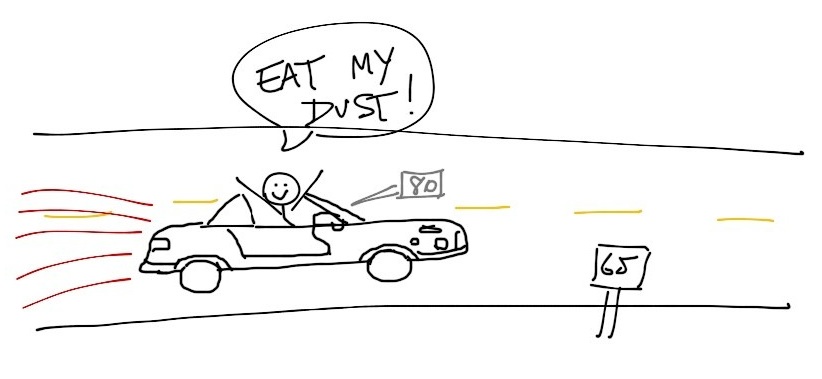
Mr. Maddox was a gentleman at peace with his prognosis; he had been granted the years to achieve that peace. He was content with his life, as long as we could help fix his shortness of breath enough so he could get back to living it. “I just want to get back out there and drive, doc!” he said. “I drive 80 on 97, I’m nothing like those old folk on the road!” Dr. Slate turned to Mr. Maddox's daughter and asked, with a twinkle in his eye, "Would you get in his passenger seat?" "Oh yes!," she exclaimed. "And that, students, is the true test," Dr. Slate said.
 Where did he want to drive to? His destinations were perhaps the most telling. Mr. Maddox loved to cook, and especially loved to cook for his daughter, who worked long shifts. He would drive meals out to her house, 30 miles away, and it gave him great pleasure to do so. Even more importantly, though, he paid weekly visits to the nursing home where his wife spent the terminal five years of her life. “That was our family, doc,” he said. “Most of them have passed on, too, but there’s five or six of them still there. I go sit with them for a few hours every week, and it gives me peace, because it’s where my wife was.”

In many ways, he reminded me of Barepapa, my grandfather – older, balding, his gentle humor laced with a tinge of sass, active and independent. Except Mr. Maddox had managed to retain those traits, while Barepapa progressively lost them in his five-year battle with Alzheimer’s. The similarities interspersed with the stark differences had me holding back tears while I was in the room, but he made it easy to smile with his good-natured acceptance of what was in the pipeline.

I struggled with how my personal experiences overlapped with so many bits and pieces of the patients’ lives throughout the day. Everything I saw and heard went through the filter of my memory – Dr. Slate warned us of it when our day began, yet my emotional vulnerability managed to sneak up on me. Even so, I cannot help but embrace it.

We witness many stages of death in our time on the wards. But the same vulnerability that brings tears to our eyes and a pang to our gut also provides us a lens beyond death to humanity, individuality and conviction. For that, a tender heart is a small price to pay.


"Anyway: I am not blessed or merciful. I'm just me. I've got a job to do and I do it. Listen: even as we're talking, I'm there for old and young, innocent and guilty, those who die together and those who die alone. I'm in cars and boats and planes, in hospitals and forests and abattoirs. For some folks death is a release and for others death is an abomination, a terrible thing. But in the end, I'm there for all of them."
-Death, Sandman #30: "Façade" (Neil Gaiman)