Showing posts with label pictures. Show all posts

Wednesday, March 25, 2015

Love and sorrow

Today marks one month from a day that was far too unexpectedly eventful, when a number of things changed in very big ways and pretty much none of them for the better. And the worst of them was, Naani died.

I don’t have a childhood, teenagehood, adulthood full of memories with her, because she lived in India, and I live here. But I still have a wealth of memories from the short spurts of time I did get to spend with her, and her larger-than-life personality helped fill the gaps left by time and distance.

She had a unique way of talking, a blend of proper language and slang that was inimitable, though Mama does a decent impression every now and then. Whenever I would hear Naani say something unintentionally hilarious, or drop a pearl of colorful wisdom, or when Mama would quote her dropping said pearl, I would think to myself, ‘I really should write these down, or record them or something, before they are lost forever.’ I never did get around to it, but in retrospect, it makes those memories and moments so much more precious.

My earliest memories of her are colored by the vagueries of childhood. We would collude in my mischief, in sneaking me treats and TV time. We would tease Mama together. Naani would help me win Hide and Seek, or protect me from Kanu’s wrath after my merciless pestering (while gently scolding me along the way). Whenever I was in India, she became my Mama Bear, and heavens help you if you messed with her grandkids.

I learned to love our conversations – by phone when I was home, or over chai and kachodi when I was in Kirti Nagar. Naani was a spiritual person, unphased by almost any trouble life threw her way. She came into her self-assuredness through preachings, and passed those along to us as we grew old enough to digest them. She emanated the same serenity otherwise only found at the temple.  

Naani was always thinking of us, her grandkids across the ocean. She had the most exquisite taste in fabrics, and would get beautiful suits made for us whenever we visited. She would make sure I got to eat all my favorite foods whenever I was home with her. She was selfless with her time and her spirit. She had such a big heart…but she really hated hugs. I made sure to give her extra ones whenever I was there.

I’m going to miss her voice, with its rough gravity. I’m going to miss bantering with her, and teasing Mama with her. I’m going to miss her palpable presence in their flat, filling every single room. I’m going to miss her playfully swatting me away when I would try to hug her. I’m going to miss curling up on her bed next to her, with my head in her lap and her hand on my head, grounding me in a way no one else could.


I’m going to miss Naani. Period.  


Friday, September 16, 2011

One Year Later


So much can happen in one year.

One year ago,
I moved to a new city
Rohit, Varun and I started on the next big journeys of our lives
I had to relearn how to forge new friendships
Meghu started her last year of high school
Neha was about to get married
The world was a little bit less of a minefield. Or a little bit more. Sometimes, it’s hard to tell.

One year ago, September 11th was the last day I saw you.
One year ago, September 16th was the day you took your last breath.

Anniversaries are strange creatures. They force you to remember, and dredge up the oddest musings along the way.

Mama and Papa redid your room a couple of months after, and converted it to a mandir. I think it helped lift the stifling aura of grief that had engulfed the room for seven years, since Barimama left us from there, right where your bed was. It was a ‘circle of life’ moment, where my two doting grandparents, who had devoted their lives to caring for each other and their family, inhabited and vacated the same space.

Whenever I need a moment, some breathing room, I sit in your room, and I can see both your faces – okay, okay, I confess, that might be because your portraits are hanging on the wall. But you know what I mean. You usually have. It sounds corny, but…I feel like I’m enveloped by that same sense of security and comfort I used to get when I was five years old, running rampant around the house under your watchful eyes. I had missed that, for the past few years, and you helped me find it again when I wasn’t expecting to.

Meghu and I still cannot bring ourselves to use your bathroom. The whole room was your space, but the bathroom especially feels like an invasion of space. It feels wrong. You had your weakest moments there, which broke our hearts even as they wove us closer together. I used it once, for the first time this summer since you left, and I couldn’t go back in afterward.

I’ve been working on my letter to you for the past 24 hours, struggling with what I wanted to share, what I was feeling, how to articulate the thoughts that have been running rampant in my head for the past several days. Today, one of my very good friends pulled me out of my head and helped me re-energize. It was a variation on your question, you know? Beta, itna kyun sochthe ho?

I never got a chance to work through a lot of my feelings surrounding how you left us, those last couple of years. Everyone should get a mandatory vacation from life for a few days after having to bid someone adieu – we need that time to process what happened, and I don’t know if I ever properly did.

While you were alive, somehow there was always an irrational hope for a miracle, defying all common sense and scientific precedent. You were my grandfather. You survived a motorcycle accident. You swam from shore-to-shore of the Ganga. You could survive anything.

When Barimama left, I was there for all the days leading up to it, and I was there minutes after it happened. When you left, I wasn’t there for those last two weeks; I last saw you five days before it happened, and couldn’t make it home until 24 hours after. Until today, I don’t think I ever realized what a significant impact that left on me.

I felt guilty for the longest time, for not being there with you. And sometimes it still doesn’t feel real, until I go back home for the weekend and the house is dead silent.

At times I feel as if I never got a chance to process that you were gone and not coming back. You left right as I began on the path that I had told you I would follow when I was a six-year-old who refused to acknowledge that she couldn’t fix her grandmother. You would treat me to a gentle smile, maybe a little indulgent, but you never laughed off my childish insistence. And that persistent support pushed me forward, reminded me what I was working toward.

Today I can say, while I fervently wish you were here to share these moments with me in person, I know you and Barimama are both watching from somewhere – probably shaking your heads and laughing a little at my antics along the way. I know, I know, I have a ways to go. But you set me on the right track, and I intend to keep at it.

Your leaving brought with it a sense of vulnerability – in sense of self, in relationships, in my perceptions of strength and eternity. You were our center, I think. And now that you’re gone, the rest of us are still trying to find and hold onto a new one. 


मेरी हँसी तो मेरे ग़मों का लिबास है, लेकिन ज़माना कहाँ उतना ग़म्शनास है । 
जब मैं उदास था तो ज़माना था खुश, अब मैं खुश हूँ तो ज़माना उदास है ।।

Thursday, September 8, 2011

Kick in the Pants

Med school started 'forreal forreal' yesterday, with Host Defenses and Infectious Diseases. So far, it is busting our chops big time. And it's barely been two days.

Exam day Tuesday didn't go quite as Ian had hoped. And tragically, this is Ian's new reality:


In other news, things I've learned so far:

The only way to get better is to get wayy worse first

And there is a profound revelation reflected in Ian's shaved head
(yes, his nose is actually that hooked. Peer closely the next time you see him; it'll creep him out)

This is kind of turning into the 'Ekta and Ian' show, isn't it? Only good things can come of it.


Monday, September 5, 2011

Don't Forget the Confetti

Today we are featuring some guest art by [drumrollllll] IAN P! Dutifully doodled on the last day of lectures before our long weekend, between the hours of 1000 and 1200. Make of that what you will.

Every exam day, Ian comes with high hopes -- of gifted A's, laptops in the air, and confetti:

 And tragically, every exam day, those hopes are dashed.

Hope springs eternal.


Friday, May 13, 2011

Fatal flaw, redeemed


A week or so ago, I was telling a friend I had identified one of my social fatal flaws: the inability to tell a white lie. I call this a fatal flaw half in jest, half with gravity.

Since when is honesty bad? An overwhelming majority of our interactions with people are made up of white lies, to make ourselves, our friends and our family feel a little better, or less worse, about themselves or a situation, to soften a proverbial blow, to keep hope alive and postpone disappointment.

What does this have to do with anything? This is not a complete non sequitur.

Last Wednesday, I attended a Peds/Neuro co-sponsored talk on learning/developmental disabilities. The speakers were two mothers. The first was not a doctor, and her daughter was born with and/or developed: central brain damage, cerebral palsy, seizures, scoliosis, osteoporosis. The second was a neonatologist, and her son had regressive autism, meaning his development was normal until he hit two years old, when he stopped speaking and responding.

The mothers were amazingly strong, self-aware, and human, admitting their weaknesses, yet not letting those weaknesses rule their actions. They spoke about their kids, the difficulties they have faced in getting the support they need, the communication issues between the kids and their parents -- how their receptive language far exceeds their expressive language, making it difficult to interpret their needs. Theirs were heartbreaking stories -- yet they came asking for awareness and advocacy, not sympathy, as mothers protecting their children and the hundreds of thousands other children whose voices are not heard.

Someone asked the mothers a question toward the end, one that stuck with me, and probably everyone who heard their stories - when you see someone in a wheelchair at the grocery store, a person with cognitive disabilities standing ahead of you in line at the cashier, what do you do? I confess that my curiosity flares up; I want to ask questions, but it's inappropriate, so I hold my tongue. But because of that, I feel awkward - should I look? Will they see my questions mirrored on my face and resent it? Should I say hello? Is it welcome? Should I look away? Isn't it rude?

Someone asked, and the mothers said: Be honest, but remember that they are there, and acknowledge them. And then added, we have kids with special needs, and we still feel awkward. It doesn't go away.

It's human.

I remember my frustration whenever someone was over at our house, and would inevitably approach my grandfather and say, "Do you remember who I am?" Once. Twice. Then, "Remember me? I'm XYZ, your son's friend." To which my grandfather would reply, "Ohh, yes, yes, I remember you, XYZ." They took it at face value -- the more sentimental would turn and say, "See? He remembers!" and the more pragmatic would nod and carry on. Eventually, my grandfather learned to game the conversation before it really began. "Do you remember who I am?" "Of course, beta [son], how could I forget?" He used the ambiguous pronoun to his full advantage.

He may have been losing his memory, and many of his higher cognitive functions, but he was still sharp, which combined with frustration was a powerful weapon. He refused to be treated as the vocal equivalent of a mime. Eventually he lost his self-defense mechanisms -- given Alzheimer's progression, it was inevitable. But the visitors' questions persisted, even though it was clear as day he had little awareness of his surroundings. It was easy for me to defend him, and to some degree denigrate the questioners. Why torture an already tortured elderly man?

But last week, I was forced to face my confusion on interacting with people who have special needs. And I realized, when faced with my grandfather, those visitors were struck with the same uncertainties and an odd mixture of concern and curiosity. Wasn't this the least offensive way to express that they care?

Curiosity can be empowering, because curiosity begets knowledge, which boasts a certain heft, shape, specificity. My mother would claim I was cursed with too many questions. I would argue I was blessed with a billion feline lives. The confounding variable in these interactions wasn't curiosity, but fear - of judgment, of perception, of hoof-in-mouth disease.

I bore witness to my grandfather's regression for four years, and the frustrating interactions he put up with throughout. But now, I can finally try to pinpoint where we go wrong. Perhaps curiosity not completely unwelcome, but only when accompanied by honest empathy. Empty words are empty. False assurances are false. Glossy conversation tries to pull a curtain over reality.

It sounds very kindergarten, but we sometimes forget the Golden Rule and instead make a spectacle out of a "freak show." But regardless of the exterior, be it glamorous or thorny, inside is someone with feelings and a personality who struggles to express themselves, or sometimes lacks the consciousness to do so. Don't mistake that hurdle for a weakness.

To take a cue from Laurel, sheath any sense of "unquestioned entitlement," and recognize their sense of self is not comprised solely or entirely of their disability. Be curious, do your homework, but don't impose yourself on them.

Let them carry on with their lives, as you carry on with your own. And if the two happen to intersect, address them with dignity, and acknowledge their humanity with your own. Wield your honesty as a gentle tool of awareness instead of a harsh weapon of insensitivity.

Fear is paralyzing. Honesty is inspiring. Initiative is rewarding.

Humanity brings us to our knees.


What though the radiance which was once so bright
Be now for ever taken from my sight,
Though nothing can bring back the hour
Of splendour in the grass, of glory in the flower;
We will grieve not, rather find
Strength in what remains behind;
In the primal sympathy
Which having been must ever be;
In the soothing thoughts that spring
Out of human suffering;
In the faith that looks through death,
In years that bring the philosophic mind.
- William Wordsworth
Excerpt from "Intimations of Immortality from Recollections of Early Childhood"

 Aadaab

Sunday, April 10, 2011

Dukes and Pirates


Signs my caffeine detox worked (AKA, ET on one cup of coffee today):

(Disclaimer: May also be signs of excessive studying and pod-induced claustrophobia. 
Read as: side effects of medical school. 
AMCAS should issue a warning label.)


 - I spontaneously start dancing in my seat like a jitterbug


(Please note, this is NOT me attempting to swing dance in my seat, which would have disastrous results, such as me falling out of my chair and suffering a traumatic brain injury after hitting my head on the corner of my bed, or perhaps more tragically, falling out of my chair and toppling my desk over, killing my cool stereo system in the process).

- I facilitate a rum-war between my Lego Jack Sparrow and my teddy finger puppet pirates

 
- I want to dunk Liz in a pit of green Nickelodeon goo to commemorate her birthday (HAPPY BARFDAY!)


- I work on a ridiculous blog entry instead of studying.

 
Ok, who am I kidding? That happens almost every time.

Tuesday, March 15, 2011

Exam-time Munchies


I know, I know, people get them all the time. But I don't get them barely ever.

Being hungry for a snack is so inconvenient when you don't have any good snacks at hand. Luckily, I remembered just in time that I still had some tortilla chips in my cabinet, and salsa in the fridge. Just in time for what, you ask? Some kind of colossal disaster, I'm sure, but luckily we will never have cause to find out, until the next time I have a salt-craving.

I'm waiting for my ghrelin to calm down and my leptin to kick in so that my stomach stops grumbling at me (and no, those are not monsters hiding in my closet; they are intestinal hormones! I bet whoever named them got a good chuckle out of it). I think if I were to name a hormone, I'd call it "savvy," for a multitude of reasons. Other suggestions?


You know what's awkward? When your stomach starts grumbling at you while you're trying to study in a quiet pod surrounded by other quietly studious people with tamer stomachs. My stomach has no sense of propriety. Granted, it is my stomach after all, but still! Poor excuse!

You know what's brilliant? Always over-estimating either how many chips or how much salsa you need to put on your plate at snack time. You leave yourself the perfect excuse to go back and fetch more of the other to make up the difference. *grin* Sometimes, eating junk food is totally worth it. Now if only I had some sharp cheddar cheese, or samosas, or chaat, or bhel puri…...

Instead, I am settling (not too much) for this, against the lovely backdrop that is the disaster zone otherwise known as my desk:


Isn't caffeine supposed to be an appetite suppressant? I guess it's busy enough keeping me awake and "focused" right now.

I suppose it's a good thing that now I can't stop thinking about renal clearance.


Thursday, December 9, 2010

A derepressing (not depressing) December

aka How I Got My Brain Stuck in the Alphabet Soup Jar

...and valiantly strove to fish it back out before 12:30pm Monday desperately hoping something had stuck.

Well, except the torture is over, so I'm not actually hysterical and can look back on this weekend with a healthy dose of amusement and sarcasm. In that vein, I invite you to enjoy a photo-essay.

I spent my weekend drowning in a sickly colored stew of enzymes and mechanisms involved in DNA, RNA, and protein replication, repair, processing, etc., with a base of genetics and modes of inheritance, flavored with diseases and molecular bio techniques, with some drugs to taste. My white board at some point said at least part of it best:
 (Ignore the cute doodles, courtesy my friend TQ; if only they were that accurate).

Despite having yet to crack the spines of any of my borrowed CMB textbooks, I felt kind of like Oasis and Ender, crushed under the weight of all that knowledge and despair:

 Raja, on the other hand, looked positively gleeful and extraordinarily pudgy conquering my mountain of textbooks:
I would almost wish to share his sentiments, except it would probably involve an immensely high volume of sugar intake to reach his girth, which is his secret source of power.

Sunday night found me studying the drug list. And consequently musing on all sorts of toxic scenarios therein. In short, I was going a little crazy:
(For the uninitiated, α-amanitin is arguably the most deadly amatoxin, in this case found in Amanita phalloides, or the death cap mushroom. It inhibits RNA polymerase II, causing the cells in your liver to burst, leading to death within a little over a week.)

Luckily, I made it to and through Monday, arguably in one piece, and hung out with a lot of pretty cool people Monday night to glory in our post-exam-ness. And as soon as I got back:

Boy was I tired.

Friday, November 19, 2010

Sworn in

Yesterday, I received my stethoscope in the mail. Today marks the two-week point since our White Coat Ceremony (shout-out to Dr. Lovering!). And this got me thinking.

One of my absolute favorite ICM sessions to date was the one a week before our ceremony, when we read through and discussed the various medical oaths that have come down through the centuries. Our profession is infused with a rich, inspiring history that brings with it the heavy weight of responsibility -- that day, we got a chance to touch on a small fraction of it.

I marked up my copies of the passages, but I just wanted to put down my thoughts on the parts that resonated the most. So, chronological order.

Hippocrates' Oath
Hippocrates, in the late 5th century B.C., set down many of the most basic tenets of medicine that we now take for granted. He swore his responsibility holding the Greek gods as witnesses. He stressed the familial/brotherhood aspect of medicine, and the importance of passing knowledge down to the next generation of disciples. His oath implied a separation between the art of medicine and the art of surgery. The oath introduced the concept of patient confidentiality. But most interestingly, in my opinion, was his very last sentence:

"If I keep this oath faithfully, may I enjoy my life and practice my art, respected by all men and in all times; but if I swerve from it or violate it, may the reverse be my lot."

He didn't settle for, oh, if I do right, I'll do okay in life, but also stressed, should I do wrong, I should suffer the consequences of the violation of my responsibility. I think that idea, while not completely lost in the revisions and versions that came later, wasn't stressed quite as much as it was here, in Hippocrates' writing.

Oath of Maimonides
Maimonides, a Jewish physician and philosopher, also invoked his faith in his oath, written in the 12th century. He brought in another crucially important idea in practicing medicine: "May I never see in the patient anything but a fellow creature in pain." I can't speak from extensive personal experience, but from what I've heard and what little I have seen, this idea sometimes is forgotten in our over-eagerness to 'fix what's wrong' with our patient, and is often difficult to face. Another stigmatized idea Maimonides made mention of is admitting that yes, even doctors make mistakes. We can't afford to freeze up in face of them, but must learn, internalize, and carry forward.

Nightingale Pledge
A pledge first taken by nurses in 1893, named after Florence Nightingale, it made mention of something I don't think was quite as explicitly mentioned in any of the other oaths. Hippocrates did make mention of not administering deadly drugs to one's patients. This pledge, however, stressed neither taking nor giving any harmful drugs, acknowledging a medical practitioner's responsibility to both self and patient. It was strange to see that the pledge didn't make explicit mention of the 'art of nursing,' so to speak, the warmth that is often associated with it.

Declaration of Geneva
The Declaration of Geneva was first written and adopted by the World Medical Association in 1948. I suppose because it was an obviously international document, it more explicitly acknowledged issues of discrimination across many lines -- religion, race, nationality, political affiliation, social status, none should come between the doctor and his/her patient. This was also the second of our selection of oaths that included anti-abortion sentiments, after Hippocrates', which I suppose given the timeframes makes sense. 

Oath of Louis Lasagna
This one was by far my favorite of the oaths. Louis Lasagna put out a revision of the Hippocratic Oath in 1964, and injected a bit of quiet humor and poetry into his comprehensive breakdown. He acknowledged ongoing research in medicine and stressed avoiding the "twin traps of overtreatment and therapeutic nihilism." Lasagna wrote of the art and science of medicine, of speaking to patients regarding matters of life and death, taking care not to play God with a patient's life, remembering that you are treating a sick human being, that prevention is preferable to curing, and that we now are joining the ranks of a society that carries many an obligation. But most important, I think, is his hope to never lose the "joy of healing."

Student Oath
The student oath we read at our White Coat Ceremony was an amalgamation of many of these oaths, and incorporated almost all of the elements I most admired in the other oaths we read through. Wearing my shiny new white coat, I stood holding a sheet of paper full of words that grew heavier in the air as I breathed life into them anew, along with the rest of my class. As I reached the end of the oath, I felt the weight of those words settle from the air onto my shoulders, woven into the seams as tightly as they were into my psyche.

And it feels simultaneously humbling and thrilling.


Sunday, October 24, 2010

Hanging with Yorick

Laurel and I spent some quality time in the pods today getting inside my skull. And I mean that literally, not figuratively.


If my blog were an anatomy atlas, I would draw in a bunch of arrows and walk you through the million foramina, fossae, and fissures therein. Thankfully, for the sake of both your sanity and mine, it isn't. Quirky person that I am, though, I will walk you through our time of hardcore studying.

He started out by sampling my caramel macchiato - I'm sure (I hope) coffee-making techniques have advanced for the better since his heyday.


Sadly, between the two of us, we polished it off pretty quick.


It potentially wasn't our brightest idea to caffeinate him, though. Pretty soon, he dived auditory meatus-first into 21st century technology, commandeering Laurel's iPod and rocking out to Outkast...


...after which he proceeded to chat up a storm of bone dust, and showed me a pencil tattoo under his eye socket that read "infraorbital fossa."

At some point, we gave up on the pretense of studying and spend many precious moments staring creepily at Laurel, much to her chagrin. Or amusement. I'm still not sure which.


We were having such a swell time, we didn't even realize it was time for solemn farewells.


On the bright side, we had a jaw-droppingly amazing time. Being crazy creepers.


(Shout-outs to Laurel, Dr. Pumplin, and Shakespeare)

Saturday, October 9, 2010

Anatomy of Stuffing

I got back home last night around 11:45pm after an afternoon/evening of studying that started around 2:30pm and existed to highly variable degrees of productivity (often at the zeroth one - and that should totally be an ordinal!). First order of business, use my $5 Amazon mp3 credit, expiring in 15 minutes. And I now have a brand new album to check out! (Thanks for the help, DTD =))

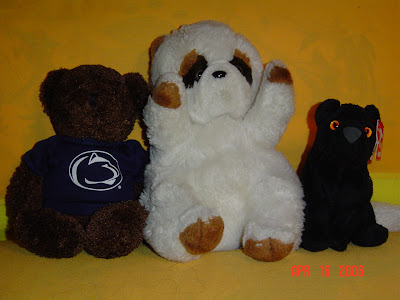
Maybe it was the late hour, maybe I was finally cracking, but as I aimlessly spun around in my chair, my eyes alighted on my stuffed animals and I found myself idly wondering what their abdominal anatomy looked like. Say what?? My anatomy vision didn't get me too far, though -- all that stuffing got in the way, especially with Raja. And Sly was just too small for me to imagine much of anything. I was trying to superimpose a liver, which would dominate his entire front and then some. Oops. Just for reference, pictures:

Sly's the impish/sleepy raccoon in the middle

And Raja is the ginormous tiger Erik is cuddling up to

Of course, the logical progression from trying to visualize Raja's intestinal structure was to Google stuffed animal anatomy! Of course. It took some digging (and I somehow managed to restrain myself for a whole 24 HOURS before more fully indulging my craziness), but I found something super-cool! This answers almost all of my unresolved, burning questions about the innards of my stuffed raccoon, though I think there may be no hope for Raja:


Okay, so he's made of gummy stuff, whatever that's made of, and not teddy bear stuffing, but close enough. And he's a bear, not a raccoon, but it works, somehow. And, talk about AWESOME. The digital artistry, the level of detail, just...wow. I am blown away.

And the artist, Jason Freeny, happened to have something that tied in semi-perfectly with what I've spent the last couple of hours tackling: the female reproductive system.


Okay, so this image jumps ahead a few months, but close enough. Umbilical cord! Hemostats! Fertilization! HUGE BRAIN! Oh, wait, that's exam 3. Let's not get ahead of ourselves here.

And this last one is especially for Kevin:


I shouldn't be allowed near my blog after, say, 8pm, because my mental processes start breaking down. Clearly.

Friday, September 17, 2010

Initials: JCT

It seems fitting somehow that the first person whose story I tell is my grandfather. And in a way it’s my own story, too – his started long before me, but mine started with him. This journey I’m now embarking on, this started with him, too.

Barepapa loved to spin a good tale, some true, most humorous. Growing up, I knew him as a singer, a jokester, a caretaker, but first and foremost, a friend. He was my first playmate, and we were thick as thieves. Being a grandparent means being the designated keeper of illicit secrets – Mister Rogers TV marathons, extra trips to the park, a third helping of ice cream.

My memories of him make up a good portion of my childhood. Our ritual of walking to school started in kindergarten, when school was actually right down the street. I had PM classes – he would get me ready, feed me chicken noodle soup, and off we went. When I came home, I would take a nap with my head in his lap, on my favorite baby pillow. He and I had a game, where I would try to sneak up on him from behind, treading softly on my tip-toes. His hearing was so sharp, he never missed a beat, always turned around and swung me up before I even got close.

He loved to take us all to the park, pushing us on the swings and vainly trying to keep his little terrors in line. I remember he always dressed sharp. Every day, he had on his dress pants, a nice button-up shirt, and a belt, with his favorite sweater vest over top, rain or shine.

Barepapa dedicated much of his life here to raising us and looking after Barimama. She passed away my first year of high school, and Barepapa took it the hardest. He suffered a string of health setbacks, and very slowly began losing his recent memories. He had begun down the path with Alzheimer’s, and it was a roller coaster from there – frustrating for him to ride, and heartbreaking for us to see. One of my saddest days was when I successfully snuck up on him, and he didn’t hear me, didn’t see me, didn’t turn around.

In his spare time, before his eyesight and motor control began to deteriorate, Barepapa had filled journal upon journal with his poetry, shairo shairee. Any time we got together for prayers, he sang his favorite bhajan, “Aye Mere Gurudev Karuna,” and as he lost his memory, that refrain increasingly echoed through our home, a lament and a prayer.

I started college close to when he began losing his memory. Every time I left for school after a weekend home, he would slip some pocket money into my hand, tell me to study hard and come back soon because the house was too quiet with me gone.  

Soon after, his memory took a steeper decline. He steadily lost his sense of self, his awareness of everyone else. I came home one weekend, sat down to tell him a story I’d heard; he sat there listening, and as I looked at him, I realized there wasn’t the faintest glimmer of recognition in his eyes. He didn’t remember who I was; that knowledge never came back, and I knew I’d lost him, thought it could never hurt more than it did then.

This past year he couldn’t take care of himself anymore. Barepapa, once such a proud, self-made, independent man, was suddenly dependent on everyone around him. The fact that he wasn’t aware of the autonomy he’d lost made it that much harder to watch, to help him.

And these past two weeks were a different kind of torture. He stopped eating two weeks ago, and I was at school, away from home, away from family, away from him, confused about how to deal with this on my own. I came home the weekend before my exam because Mama wasn’t sure he would make it to Monday afternoon when I got done, and I’m so glad I got a chance to see him, to talk to him, even if he couldn’t respond. My leaving didn’t make the house quiet; his leaving did.

When he passed away Thursday morning, I somehow felt I hadn’t just lost my grandfather, my oldest and dearest friend, but also lost my last connection to my grandmother. They both made me who I am, were my inspiration, my driving force my entire life, and I didn’t know how to handle the thought of losing both of them, what felt like a second time.

And then one of my closest friends in high school, whose grandfather passed away a year after Barimama, wrote me a beautiful e-mail. She said, “One of the only things that made me smile when my grandfather died was something you wrote me in a card that I’ve always kept. You asked me to imagine our grandparents sitting in heaven somewhere having tea together, happy and free of all their earthly burdens.” She re-gifted me a precious image, of Barepapa and Barimama meeting again, sitting on a bench somewhere, spending eternity together sipping chai and gossiping about the rest of us.

Throughout high school and college, he would write me little notes, and I always kept one with me in my wallet, reading it when I was thinking of him. The latest one was a quote he transcribed for me:

“Everything will straighten itself in time
Only we need patience, faith, self-surrender,
The Lord is great
HE knows best the purity of every thought, action, and motive.”
-Swami Chinmayananda

And he also wrote something it seems especially for us today:
“We should never be afraid of tears. They soften our hearts, wash our eyes, and clear our vision.”